
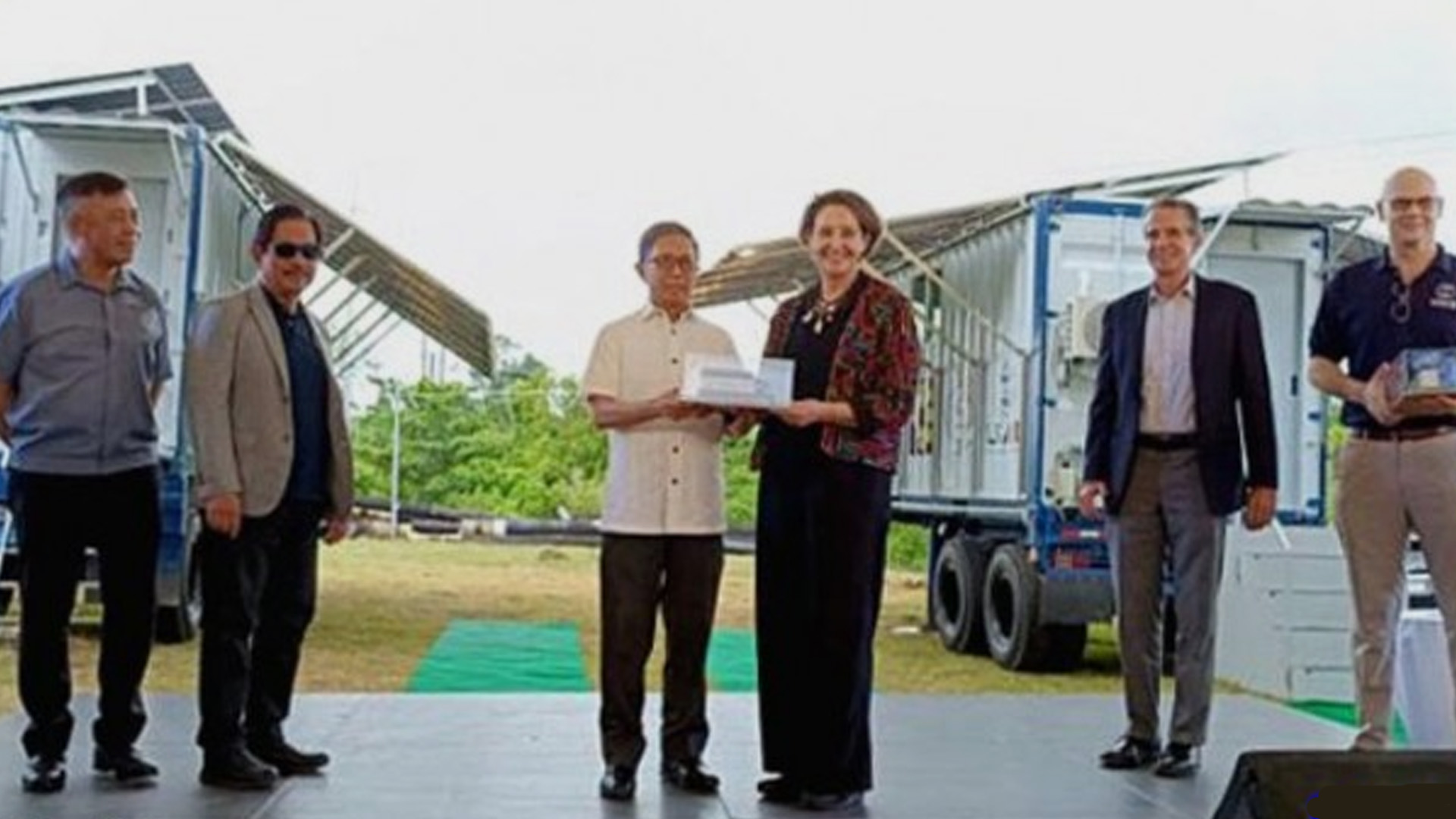







The Department of Energy (DOE) and the United States Agency for International Development (USAID) on Friday turned over three Mobile Energy Systems (MES) to the National Power Corporation-Small Power Utilities Group (NPC-SPUG) in Puerto Princesa, Palawan.
The units, developed under the USAID Energy Secure Philippines program, are solar-powered battery-equipped platforms designed to provide electricity to off-grid areas during disasters and emergencies.
These will be deployed to remote communities in Palawan that are not connected to the main grid.
“These MES units represent not just a technological innovation, but a shared vision for energy security and resilience,” DOE Secretary Raphael Lotilla said, who led the turnover ceremony with United States Ambassador to the Philippines MaryKay Carlson and NPC President Fernando Martin Roxas.
Lotilla said the MES units would help reduce fuel costs and improve energy access in isolated areas.
A 70-kilowatt hour (kWh) MES can save up to PHP480,000 annually in fuel, while a 50-kWh unit can save over PHP389,000.
“Every peso saved from imported fuel is a peso reinvested into our communities. Every kilowatt-hour generated locally strengthens our energy independence,” Lotilla added.
Palawan, often called the country’s “last frontier”, frequently faces power disruptions due to its geographic isolation.
The MES units are expected to support critical services such as healthcare, emergency communications, and local infrastructure during outages.
Aside from the units deployed in Palawan, two MES units are operating in Cagayan province, with another at the DOE office in Taguig City.
Four more units are scheduled for turnover next month. (PNA)